
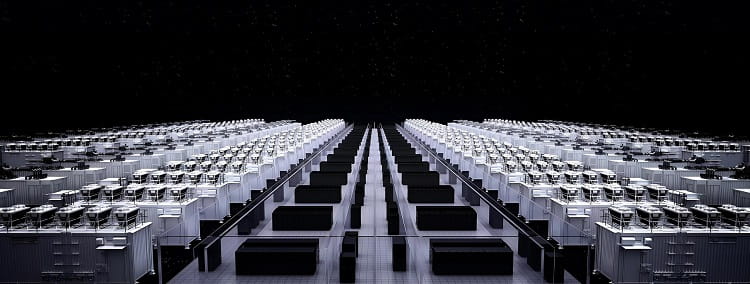
Growth seldom arrives as a perfectly even load curve: one computing building may reach capacity while the next is still being fitted out. For hyperscale data center, system interfaces shape the real outcome. Huawei Digital Power outlines a facility portfolio that combines smart power supply, cooling, monitoring, and modular construction. The products have separate duties, but their interfaces determine whether computing capacity can be added without interrupting existing halls.
Design the power path around the IT load
Medium- and large-scale halls generally separate incoming utility distribution, UPS protection, battery backup, and downstream distribution to the IT load. Huawei positions smart power supply and distribution as components of its data center facility offering; electrical redundancy must still be engineered for the selected topology and local standards.
A modular power architecture can provide additional capacity in stages, but spare physical slots do not create spare upstream capacity. Cable routing, fault protection, maintenance clearances, and commissioning windows must be reserved at the initial design stage.
Match cooling to dense computing
The smart cooling portfolio addresses heat removal at room and infrastructure level, while deployment decisions depend on rack heat density and acceptable inlet conditions. Liquid and air-based methods can be used in different areas of a campus, provided the thermal and hydraulic interfaces are properly coordinated.
Airflow management remains fundamental even where liquid cooling is deployed for processors. Containment, return-air paths, sensor placement, and equipment clearance influence how consistently the cooling system protects adjacent electronics.

Use monitoring to connect facility systems
Data center management systems can consolidate information from power equipment, cooling devices, and environmental sensors. A DCIM layer such as NetEco6000 gives facility teams a way to examine alarms and trends, while on-site protection and control remain within the equipment designed for those functions.
Historical trends can inform decisions about power-module additions, thermal rebalancing, and preventive inspections. They are not a substitute for a maintenance plan or for testing failure scenarios under controlled conditions.
For staged expansion, engineers should freeze the interface assumptions for each phase, including feeder routes, cooling connections, sensor locations, and maintenance access. Otherwise a later hall can change the risk profile of a live one.
Commission each expansion as a system
The facility portfolio includes smart modular and prefabricated modular data center approaches. Their value lies in pre-integration and repeatable interfaces, but each new module still has to be checked against the site grid connection, fire design, network routes, and existing controls.
Operators often benefit from standardizing labels, maintenance procedures, and monitoring points across buildings. Such consistency shortens the time required to diagnose anomalies when different halls were constructed years apart.
For hyperscale operators, the decisive issue is how power, thermal management, monitoring, and modular delivery work together through successive growth phases. Product capabilities provide the building blocks; the site-specific load model, redundancy design, and commissioning process determine their practical value. For hyperscale data center, Any claimed benefit should be assessed under realistic loads, environmental conditions, and the local operating policy.