

For a renewable microgrid coordinating storage with diesel units, equipment decisions must follow the required service and the conditions of the actual site. A microgrid controller controls how a local network switches between operating modes and monitors the interaction of dispersed power resources. The Fusion Solar smart microgrid portfolio identifies Huawei’s SPPC2000-MGCC as a specialized controller for voltage-frequency coordination, switching, and PV-battery-diesel dispatch. Instead of a single, isolated device, a microgrid controller in this case combines certain parts and controls.
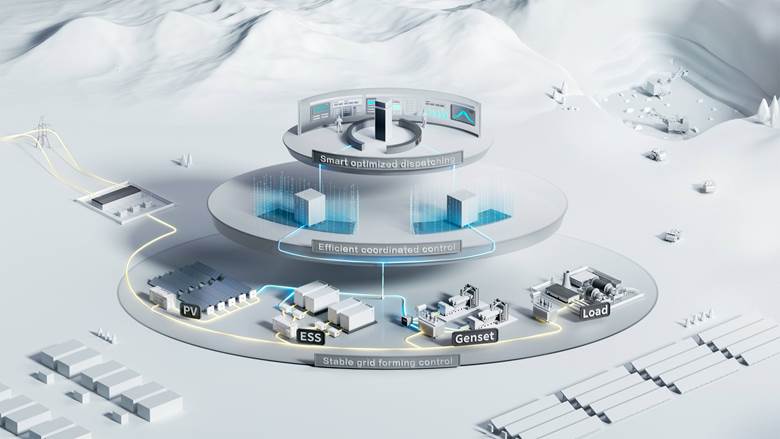
Coordinated dispatch is necessary during load variations since storage and diesel generation have varying response times. Therefore, prior to commissioning, equipment ratings, control regulations, and operating team roles should be in line. When a design assumption cannot yet be verified by measurements, it should be recorded.
Measurement and control architecture
The device supports active/standby and master–slave control arrangements in specified configurations. Redundancy planning needs to cover both control hardware and communications, with the failure modes documented during detailed design.
Instead of taking over the internal protection and power conversion functions of generators, PV inverters, and grid-forming storage, a supervisory controller coordinates them. Every equipment class should have clear command authority and safe fallback states.
Frequency, voltage and switching
The published controller specification lists multi-time-scale voltage and frequency regulation with a response delay below 10 ms for stated configurations. This is a device-level capability; whole-microgrid behavior depends on connected converters and power-system dynamics.
A mode change requires correct breaker status, grid condition detection and coordination with grid-forming equipment. Uncontrolled reconnection can create electrical stress, so synchronizing and interlocks are critical.
Dispatch and protective coordination
The controller can coordinate PV, battery storage and diesel generation to support local demand. Economic dispatch is bounded by generator operating limits, energy storage reserve and requirements for maintaining a stable grid reference.
Different control tasks include slower energy scheduling and short-term frequency support. While supervisory logic modifies power setpoints at longer intervals, a well-designed hierarchy keeps fast converter reactions accessible.
Testing and operations
Commissioning should check PT/CT polarity, voltage and current scaling, equipment addresses, command responses and redundant-path behavior. Small configuration errors in measurement can produce major errors in dispatch.
Operations teams need event records for switching commands, voltage-frequency excursions, communication losses and resource availability. These records help distinguish the controller response from the behavior of downstream equipment.
These considerations show why microgrid controller should be specified by its architecture, operating limits and interfaces. For a complicated electrical network, the controller provides a coordinated decision layer. Only when metering, converters, protection, and commissioning have been designed as a single operating system are its stated reaction capabilities significant. The final decision is still based on relevant standards, site conditions, and model-specific data.